The Bird-Dog I Do on My Living Room Rug Every Morning — The Wobbly Core Drill That Steadied My Back in Four Weeks
I found the bird-dog by accident, the way I find most of my home exercises: not in a gym, not from a fancy program, but from a physio video I watched at 11 pm while sitting on the floor with my laptop balanced on a cushion. My back had been grumbling for weeks. Not the dramatic kind of ache that sends you to bed, just that low, nagging stiffness that shows up when you stand up from the sofa and makes you go "oof" before you catch yourself. I was doing planks, I was stretching, I was doing all the things people tell you to do, and it still felt like my middle was made of wet cardboard. Then this woman in the video got on all fours, reached one arm forward and the opposite leg back, and held it like it was the easiest thing in the world. I tried it on my rug the next morning. I wobbled so hard I nearly face-planted into my coffee table. That wobble, it turned out, was the whole point.
Four weeks later, the bird-dog is the first thing I do after I put the kettle on. It takes about four minutes. It looks like nothing, and my back feels steadier than it has in months. Getting out of bed doesn't come with that little brace-yourself moment anymore. Carrying the laundry basket up the stairs doesn't make my lower back tighten up halfway. Those are small wins, but when you've lived with a grumbly back, small wins are the ones that actually change your day.
So this is my honest account of a month with the bird-dog: what it is, how I learned to do it without flailing, the mistakes that made it useless for the first week, and the exact little routine I do now. No equipment, no mat needed if you've got a rug, and no pretending it's magic. It's just a quiet, slightly humbling drill that taught my core to do its actual job.
What a bird-dog actually is (and why it looks too easy)
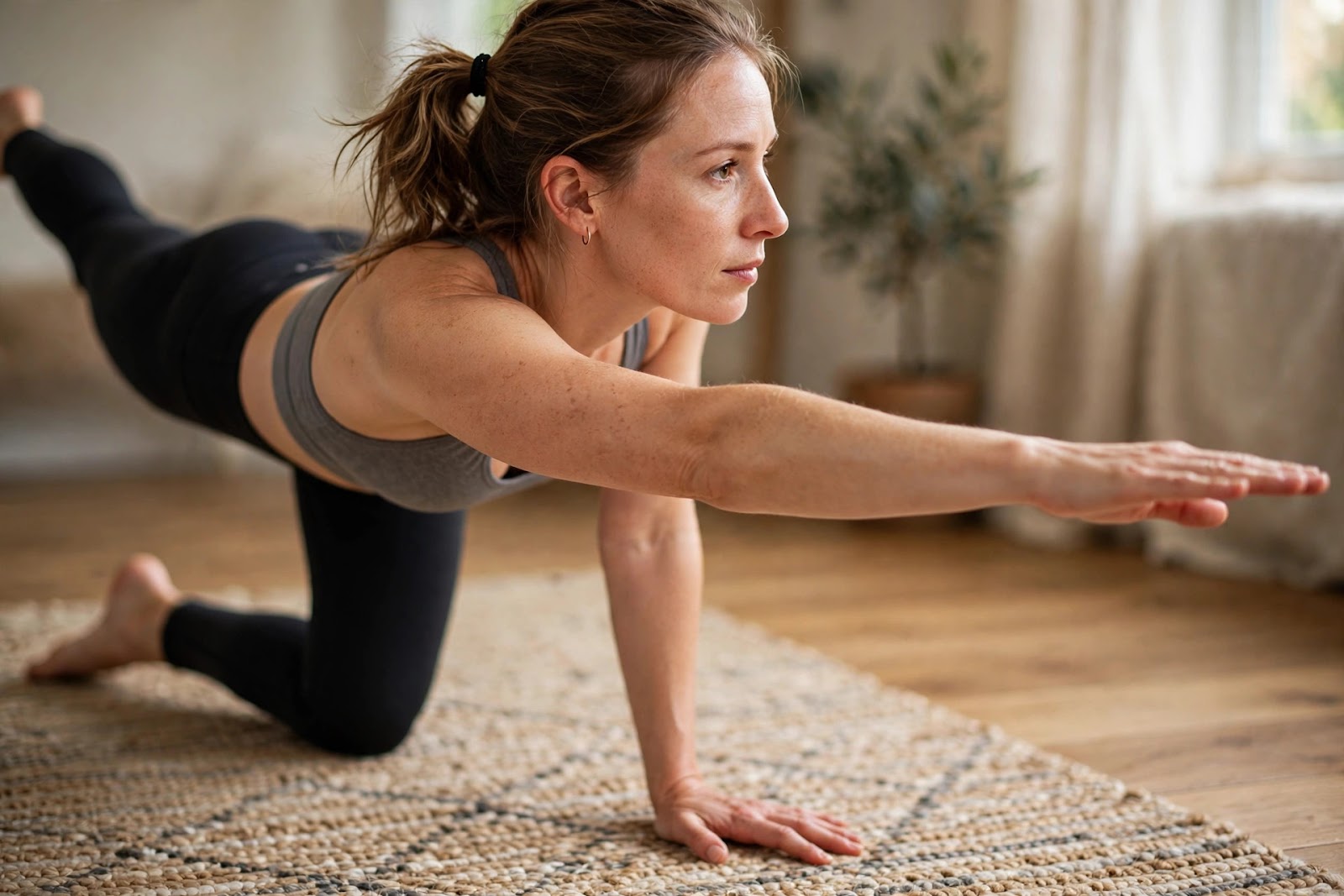
The bird-dog is simple on paper. You start on all fours — hands under your shoulders, knees under your hips. Then you reach your right arm straight out in front of you and your left leg straight out behind you, at the same time, until both are roughly level with your body. You hold that for a few seconds, breathing normally, then bring them back down and switch sides. That's one rep each side.
Here's the thing nobody tells you the first time: the hard part isn't holding your arm and leg up. It's keeping everything else still. Your hips want to tilt. Your lower back wants to sag like a hammock. Your supporting knee wants to slide. The first time I tried it, my hips rocked side to side like a boat, and my arm drifted out to the side instead of straight ahead. I looked like a dog pointing at something very exciting across the room. It was not graceful.
That stillness is the whole exercise. When one arm and the opposite leg leave the floor, your trunk has to work to stop you from tipping over. The muscles around your middle — the ones that are supposed to brace you when you pick up a shopping bag or reach for something on a high shelf — get a proper job to do. A plank asks them to hold still in a straight line. The bird-dog asks them to hold still while your limbs move, which is much closer to real life. Real life is never a perfect straight line. Real life is reaching, twisting, carrying, catching yourself when you trip over a shoe.
The morning I nearly fell on my face
Let me tell you about that first attempt properly, because it explains why I almost quit on day one. It was a Tuesday. I'd put the kettle on, rolled out my rug — I don't own a yoga mat, the rug in front of my sofa is my gym floor — and got on all fours in my pyjamas. I reached my right arm out and my left leg back, and immediately tipped sideways. My left hand slipped a little on the rug, my knee wobbled, and I had to catch myself with my elbow. I laughed, which didn't help my balance at all.
I tried the other side. Same story. My leg kicked up too high, my back arched, and I could feel my lower back doing all the work instead of my stomach muscles. I did about four wobbly reps, stood up, and thought, well, that was humbling. My first instinct was to file it under "exercises that aren't for me" and go back to planks, which at least I could do without looking like a newborn deer.
But the video had stuck in my head. The woman in it had said something I kept coming back to: if you wobble, that's information, not failure. The wobble shows you where you're weak. So I gave it three more mornings before deciding. That turned out to be the right call, because day three was already noticeably less chaotic than day one. Not good. Just less chaotic. And less chaotic was enough to keep me going.
How I set it up (my rug, my rules)
My setup is boring, because boring is what I actually stick to. I do it on the rug in my living room, right after I switch the kettle on and before I make breakfast. The kettle takes about three minutes to boil, and the bird-dog takes about four, so the timing works out: by the time I'm done, the water's ready and I'm awake.
I wear whatever I slept in, plus socks with a bit of grip. Bare feet work fine too, but my rug is a bit slippery in socks, so I tuck my toes under properly and spread my fingers wide on the floor. Hands go directly under my shoulders, knees directly under my hips. I check that in the mirror on the wall the first few times — not to admire my form, but because my hands kept creeping forward like I was about to do a push-up.

I do it on all fours on the rug because the floor is hard and my knees complain on bare wood. If you've got a mat, use it. If you've got carpet, use that. A folded blanket works too. The surface matters less than the habit: same place, same time, same cue. For me the cue is the kettle clicking on. If I wait until "later," later never comes. You probably know that feeling too.
The exact way I do it now
After four weeks of fiddling, this is the version that actually feels right. I start on all fours and take one slow breath. I pull my belly button gently toward my spine — not sucking in hard, just a light brace, like someone's about to poke you in the stomach and you're ready for it. I press the floor away with my supporting hand and knee, so my shoulder blades feel wide and my back feels long, like a tabletop.
Then I reach my right arm forward, thumb up, and my left leg back, foot flexed, toes pointing down toward the floor rather than up at the ceiling. I think about reaching long, not lifting high. My arm and leg should end up roughly in line with my body — if they go higher than my back, my lower back arches and starts complaining, and that's my signal to lower them a touch. I hold for five slow seconds, breathing the whole time. In through my nose, out through my mouth, no holding my breath.
Then I bring the arm and leg back down slowly — this is the part I used to rush — set them down softly, take one breath, and switch sides. Left arm, right leg. Same five seconds. That's one round. I do six rounds, which is twelve reps total, three per side per... no, wait, let me count that properly: six rounds means six reps per side, twelve in total. It takes about four minutes including the little breaths between sides.
The five mistakes that made my first week useless
I made every beginner mistake with this drill, so let me save you the week I wasted. Mistake one: lifting my leg too high. I treated it like a donkey kick and swung my leg up toward the ceiling, which arched my lower back and made the whole thing a back exercise instead of a core exercise. The fix was thinking "reach long" instead of "lift high." My foot only needs to get to hip height, and if my back starts arching, I lower it an inch or two until the arch disappears.
Mistake two: rushing. My first reps lasted about one second each because I was in a hurry to get to the other side. A one-second hold teaches you nothing except how to flail quickly. Five seconds feels much longer than you'd think when you're wobbling, and that's the point. The hold is where the work happens. If five seconds is too much at first, three is fine. Three honest seconds beats five rushed ones.
Mistake three: holding my breath. I kept catching myself going red in the face because I'd forgotten to breathe entirely. Now I deliberately breathe out as I reach out, and breathe in as I come back. If you notice you're holding your breath, you're probably bracing too hard or going too fast. Slow down and breathe. It sounds obvious. It took me a week.
Mistake four: letting my hips rotate open. Every time I lifted my left leg, my left hip would swing open like a door, and my whole body would twist. The fix was imagining a glass of water balanced on my lower back — silly, but it works. I try to keep my hips level, pointing straight down at the floor, even when my leg wants to swing out. Some days my hips still open a little. On those days I slow down and shorten the reach.
Mistake five: looking up. I kept lifting my chin to look at my hand, which cranked my neck and threw my balance off. Now I look down at the rug between my hands, keeping my neck long and in line with my spine. My gaze stays on one spot on the rug, and that spot becomes my anchor. Pick a thread in the rug, a pattern, a crumb — whatever. Just keep your eyes there.
Week by week: what actually changed
Week one was mostly damage control. I did it every morning, five reps per side, three-second holds, and I wobbled through most of them. My knees hurt a little from the rug until I folded a towel under them. My wrists ached on day two because I was dumping all my weight into my hands. I fixed that by spreading my fingers and pressing through my whole palm instead of just the heel of my hand. By day five, I could get through a set without having to catch myself. Small victory, but I took it.
Week two was when it started to click. I moved up to five-second holds, the wobble dropped noticeably, and I could feel my stomach muscles switching on before my arm even left the floor. My back felt less stiff in the mornings, particularly in that first half hour after getting out of bed when everything used to feel rusty.
Week three, I noticed the changes outside the exercise. I carried groceries in one hand and reached for the front door with the other without twisting awkwardly, and I picked up a laundry basket without that little "brace yourself" pause I used to do. Tiny, unglamorous moments — and exactly the kind of thing a core drill is supposed to help with.
Week four is where I am now. The bird-dog feels like a habit rather than a challenge. I still wobble on tired mornings — if I slept badly, my balance is worse, and that's fine, I just slow down. My back feels steadier through the day, especially in the late afternoon when I used to slump at my desk and feel everything tighten up. I can sit at my desk longer without fidgeting, and when I stand up, there's no creaky unfolding routine. I won't oversell it: I still get stiff if I sit for three hours straight without moving. The bird-dog didn't make me invincible. It made me steadier, and steadier is plenty.
The version for bad mornings
Not every morning is a good bird-dog morning, and I had to learn a gentler version for the days when my back is already grumpy or I slept in a weird position. On those days I do the same drill, but I only lift my arm, keeping both knees on the floor. Then I only lift my leg, keeping both hands down. Splitting it in half takes away most of the balance challenge, but it still wakes the muscles up, and it never makes a grumpy morning worse.
Some mornings I shorten the reach too — arm out to shoulder height but only halfway, leg back but barely off the floor. It still counts. I used to think a half version was cheating. It's not cheating; it's adjusting. The goal is to move a little every morning, not to perform the perfect bird-dog for an invisible judge.
What I pair it with (and what I don't)
The bird-dog isn't my whole workout — it's the opener. After it, most mornings I do a few glute bridges and a slow standing stretch, and then I get on with my day. On the days I do a longer home workout in the evening, the bird-dog is still there in the morning, doing its quiet little job. It doesn't replace strength training or walking or anything else. It just fills a gap I didn't know I had: the gap between "my core is strong in a plank" and "my core actually helps me when I move around."
I do it before coffee, not after. Before coffee my brain is still quiet, and that small detail is the difference between a habit that sticks and one that fades by week two.
How to start if you're as wobbly as I was
If you try this tomorrow and wobble all over the place, welcome to the club. Here's the start I wish someone had given me on day one. First, fold a towel or blanket under your knees — sore knees will kill a habit faster than anything. Second, do it next to a wall or a sofa you can touch if you tip. I kept my sofa within arm's reach for the first week, and I used it twice. No shame in that.
Start with three-second holds and four reps per side. That's about two and a half minutes. Do that for a week before you add anything. When three seconds feels steady, go to five seconds. When five feels steady, add a rep or two. That's the whole progression, and it's boring, and boring progress is still progress. I added a second too early in week two and my form fell apart for two days, so I went back down and rebuilt. There's no prize for rushing.
Keep a tiny note of how it feels — one line a morning, like "wobbly, wrists sore" or "steadier, back looser." Day-to-day changes are too small to notice, but a week of notes shows a clear line from chaos to calm.
What it didn't fix (honest bit)
I want to be straight about the limits, because every fitness article that only talks about wins is lying by omission. The bird-dog did not fix my posture at my desk — I still slouch by 4 pm if I don't get up and move. It did not make my stomach flat or give me visible abs; that's not what it's for, and anyone who tells you a four-minute floor drill will do that is selling something. It did not replace walking, and on the days I skip my walk, my back notices regardless of how many bird-dogs I did.
So if your back feels wobbly and unreliable in everyday movements, this is worth four minutes of your morning. If your problem is somewhere else entirely — your knees, your shoulders, your energy — go and find the drill that matches that problem. There's no single exercise that fixes everything, and anyone who says otherwise hasn't tried to fix everything with one exercise.
My routine now, in one place
Here's the whole thing, exactly as I do it now, so you can copy it or tweak it. Kettle on. Rug, towel under knees, hands under shoulders, knees under hips. Belly braced gently, back long like a tabletop. Right arm and left leg reach out long, five slow seconds, breathing out as I reach. Down slow, one breath, switch sides. Six reps per side, twelve total, about four minutes. Sit back on my heels for a few seconds, stand up, make tea.
Four weeks in, I don't think about it much anymore, and that's the best review I can give it. It went from a humbling wobble-fest to a quiet part of my morning, like brushing my teeth. My back feels steadier, my mornings feel less creaky, and the laundry basket no longer feels like a test of character. If you give it a week — a real week, wobbles and all — I'd love to know whether your rug becomes your favourite bit of floor too. Mine certainly has.


