My rest days used to be a disaster dressed up as recovery. I'd finish a hard Saturday workout, feel proud of myself, and then spend Sunday welded to the sofa in a way that left me stiffer on Monday than I'd been on Friday. My knees creaked getting up. My shoulders felt like they'd been shrink-wrapped overnight. And I genuinely believed that was just how rest days worked — you do nothing, you get stiff, you push through it on Monday.
Then a friend who trains as a physiotherapy assistant said something that stuck with me: "Rest doesn't have to mean still." She told me about isometric holds — exercises where you push against something that doesn't move, or hold a position without moving at all — and how she used them with people who needed strength without joint stress. No jumping, no pounding, no equipment. Just tension, held still, on purpose.
I was sceptical, mostly because holding still sounded like the opposite of exercise. How could standing in a wall sit possibly count? But my Monday-morning stiffness was getting worse, not better, and the sofa approach clearly wasn't working. So I built a ten-minute isometric routine for my rest days and gave it four weeks. My Monday mornings have never felt the same since.
What isometrics actually are (and why they work on a rest day)
An isometric exercise is any move where your muscles work hard without your joints moving. A wall sit. A plank. Pushing your palms together as hard as you can. Your muscles are contracting, your body is burning energy, but nothing is travelling through space. That's what makes them perfect for rest days: they build strength and wake up sleepy muscles without the impact or soreness of a full workout.
There's a second benefit nobody talks about enough. Holding a position forces you to pay attention to your body. You can't zone out during a forty-second wall sit the way you can during a mindless set of bicep curls. Your brain has to stay in the room, noticing which muscles are working and which ones are cheating. That body awareness carries over into everything else you do — your squats get steadier, your posture improves, and you start catching sloppy form before it becomes a habit.
One honest note: isometrics won't replace your main workouts. They won't build big muscle on their own and they won't raise your heart rate the way a circuit does. They're a supplement, not a substitute. Think of them as maintenance — the ten minutes that keep the machine running smoothly between the real sessions.
The routine: six holds, ten minutes, zero equipment
I do this on Sundays and Wednesdays, my two rest days, usually mid-morning after I've had a glass of water and before the day gets away from me. The whole thing takes ten minutes. Six holds, each done twice, with about twenty seconds of rest between them. Here's exactly what I do.
1. Wall sit — forty seconds
Back flat against the wall, slide down until your thighs are parallel to the floor, knees over ankles, arms relaxed at your sides. Hold. This is the one everyone knows, and it's the one I underestimated most. The first Sunday I lasted twenty-eight seconds before my thighs started shaking and I slid down the wall like a melting candle. By week three I was holding forty seconds twice through without drama, and the shake had moved from "panic" to a gentle tremble I could breathe through.
2. Glute bridge hold — thirty seconds

Lie on your back, knees bent, feet flat on the floor, and lift your hips until your body makes a straight line from shoulders to knees. Squeeze your glutes hard and hold. My glutes used to be the laziest muscles I owned — after years of sitting at a desk, they'd basically retired. The first week I could barely feel them working; my lower back and hamstrings did all the cheating. The fix was simple and humbling: I put my hands on my own glutes during the hold (yes, it looks ridiculous, no, nobody was watching) until I learned what the squeeze was supposed to feel like.
3. Dead hang from the doorframe bar — twenty seconds
I have a pull-up bar wedged in a doorframe — the same one I've owned for years and mostly used as a clothes rail, if I'm being honest. Grip it, lift your feet, and just hang. Shoulders relaxed, not shrugged up to your ears. The first hang lasted eleven seconds and my forearms screamed. By week four I was hanging for thirty seconds and my shoulders felt looser afterwards than they had in months. If you don't have a bar, a sturdy doorframe ledge works, or skip this one and add ten seconds to the plank instead.
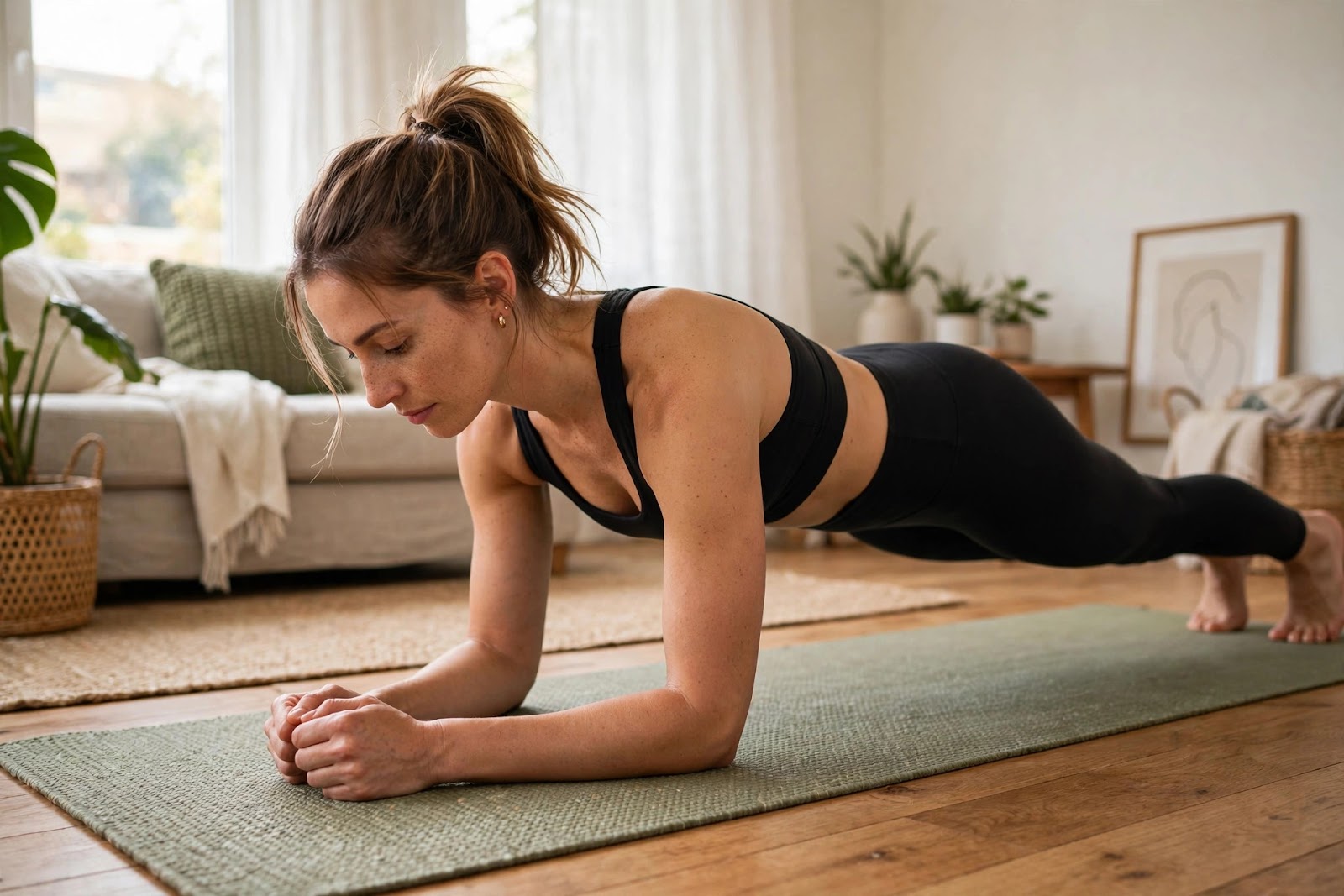
4. Plank — thirty seconds
Forearms on the floor, body in a straight line, belly braced like someone's about to poke you in the stomach. The plank is the most lied-about exercise in home fitness — everyone claims a minute, most people are sagging at the hips by second twenty. I set my phone on the floor to film myself from the side on day one, and the footage was brutal: my hips were sagging like a hammock. Fixing that one thing — squeezing my glutes and tucking my pelvis slightly — made the hold harder and far more useful.
5. Hollow-body hold — twenty seconds
Lie on your back, lift your shoulders and legs a few inches off the floor, arms reaching forward, lower back pressed into the mat. Hold. This is the hardest move in the routine and the one I still can't do perfectly. My legs start to drop at fifteen seconds and my lower back arches off the floor. That's fine — I bend my knees slightly when I need to, which makes it easier without losing the point of the exercise. Progress, not perfection.
6. Calf raise hold — thirty seconds
Stand on both feet, rise up onto your toes as high as you can, and hold. Sounds easy. It isn't, especially on the second round when your calves are already tired from everything else. I do this one near the kitchen counter so I can touch it lightly for balance. The first week I wobbled so much I had to put my feet down twice. By week four I was holding steady for the full thirty seconds, and my ankles felt noticeably sturdier on the stairs.
What changed in four weeks
Week one was mostly a lesson in humility. My wall sit was twenty-eight seconds, my dead hang was eleven, and my plank looked like a hammock. But even in week one, something shifted: I woke up on Monday and my body felt used, in a good way — like it had done something, rather than rusted in place all weekend.
Week two, the numbers started moving. Wall sit: thirty-five seconds. Dead hang: seventeen. And my Monday stiffness, the whole reason I started this, was already noticeably less. I could get out of bed and walk to the kitchen without that first-minute shuffle. That alone was worth the ten minutes.
Week three, the routine started to feel like a habit instead of a chore. I stopped checking the clock every five seconds. My glutes finally showed up to the bridge hold without me having to poke them first. And my regular workouts got better — my squats felt steadier, my push-ups felt stronger, and I realised the isometric work was quietly teaching my muscles to fire in the right order.
Week four, I re-tested everything. Wall sit: fifty seconds. Dead hang: thirty. Plank: forty-five with good form, hips level. Hollow hold: twenty-five seconds before my legs dropped. And the Monday shuffle? Gone. I get up, I stretch my arms overhead, and I walk to the kitchen like a normal person. It's a small thing, but if you've ever had stiff Monday mornings, you know it's not small at all.
The mistakes I made (and the one that actually hurt)
Mistake one: holding my breath. I did this in every single hold for the first two weeks, and it gave me a headache after one session. You have to breathe — slow, steady breaths, in through the nose, out through the mouth. If you can't breathe, the hold is too hard. Back off and build up.
Mistake two: going for maximum time on day one. I tried a sixty-second wall sit in week one because my ego said I could. My knees complained for two days afterwards. Start at half of what you think you can do. Isometrics reward patience and punish showing off.
Mistake three: doing the routine on the same days as hard leg workouts. I tried stacking it after a heavy squat session once, and my legs simply refused. Rest-day isometrics belong on rest days. That's the whole point.
And the one that actually hurt: I did the dead hang with cold hands on a cold bar one winter morning, my grip slipped, and I landed awkwardly on my heels. Nothing serious, just a jolt and a bruised ego — but now I always do a minute of arm circles and shoulder rolls first. Warm up, even for a ten-minute routine. Especially for a ten-minute routine.
How to fit this into your week
If you train three or four days a week, slot this in on two of your rest days. Ten minutes, that's all. Do it in your living room, in your pyjamas if you like — I have, more than once. Keep a note of your hold times on your phone, because watching the numbers climb is the thing that keeps you coming back. I started at twenty-eight seconds on the wall sit and I'm at fifty now. That's not a world record, but it's mine, and it means my legs are genuinely stronger than they were a month ago.
If you're brand new to exercise, this is actually a brilliant place to start. No coordination required, no impact, no equipment, and you can do every hold at your own level. If a thirty-second plank is too much, do fifteen. If a wall sit at parallel is too deep, slide up a few inches. The position matters more than the depth, and consistency matters more than either.
Four weeks ago, my rest days were a sofa-shaped trap that left me stiffer than before. Now they're the ten quiet minutes that keep my whole week working. My Monday mornings are easier, my workouts are steadier, and my body feels like it belongs to someone who actually uses it. Ten minutes, six holds, zero equipment — and the best part is, the sofa is still there afterwards. It just doesn't own me anymore.


