I found wall Pilates the way I find most of my workouts now: half-watching a video while eating toast over the sink. A woman in leggings was lying on her back with her feet up a wall, doing slow leg circles, and the caption promised a stronger core in 28 days. I rolled my eyes so hard I nearly dropped the toast. I'd been doing home workouts for three years by then. I'd survived the plank challenge, the resistance-band phase, the month I did a hundred squats a day. A few leg circles against a wall were not going to impress me.
But the video kept showing up. Different women, same wall, same slow movements. And my lower back had been nagging me for weeks — not pain, exactly, more like a dull complaint every time I sat too long at my desk. So on a rainy Sunday in early October, I cleared a strip of floor by the living-room wall, put my phone on the floor with a timer, and decided to give it thirty days. If it was nonsense, I'd have a funny story. If it worked, I'd have a stronger core. Either way, cheap experiment.
Thirty days later, I'm still doing it. Not because a caption told me to, but because my back stopped complaining, my jeans fit differently around the waist, and — the part I didn't expect — my balance got noticeably better. Here's the honest version of what wall Pilates actually is, the exact routine I did, and the mistakes I made so you don't have to.
What wall Pilates actually is (no mystery, no magic)
Regular Pilates is a system of slow, controlled movements built around your core — the deep muscles around your belly, hips, and lower back. Wall Pilates is the same idea with a wall doing half the work. Your feet press against the wall, which gives you something stable to push into, and that changes everything. Movements that feel wobbly on a mat suddenly feel doable, because the wall tells your body where it is in space.
That's the whole trick, and it's a good one. When I did my first set of wall leg circles, I could feel muscles along the inside of my thighs and low in my belly switching on — muscles I'd never felt during a hundred squats. The wall wasn't making the exercise easier. It was making it more precise. Instead of flailing around trying to balance, I could focus on the actual movement.
One thing worth saying plainly: this is not a replacement for heavy strength training, and it won't turn you into a gymnast. It's a low-impact, joint-friendly way to build core strength, posture, and body awareness. If you want bigger biceps, go lift something heavy. If you want to stand taller, move better, and stop your back from grumbling at you every afternoon, this is worth a look.
The setup: a wall, a mat, and ten minutes of honesty
You need a clear stretch of wall about two metres wide, a yoga mat or a folded blanket, and a timer. I use the wall beside my sofa, which means I have to shove a side table out of the way first. That takes twenty seconds and I've stopped resenting it. Wear socks with a bit of grip if your feet slide on the wall — mine did on day one, and I spent the first session repositioning my feet every thirty seconds.
I did the routine four days a week, always in the morning before my first coffee, because that's the only time nobody interrupts me. Each session took about twenty-five minutes once I knew the moves, closer to thirty-five in the first week while I was still figuring out where my arms went. I kept a notebook on the floor next to the mat and wrote down what felt hard, what felt easy, and anything that hurt. That notebook turned out to be the most useful part of the whole month.
The five moves I did every session
I kept it deliberately simple: five moves, two rounds each, no fancy equipment. Here's exactly what I did, in the order I did it.
1. Wall bridge with feet on the wall

Lie on your back, scoot close enough to the wall that your knees bend at about ninety degrees with your feet flat against it. Press through your heels, lift your hips until your body makes a straight line from shoulders to knees, hold for three seconds, lower slowly. I did twelve reps. The first time, my hamstrings cramped at rep eight and I had to laugh at myself — a bridge, of all things. By week three I was doing fifteen reps and holding the top for five seconds without thinking about it.
2. Wall leg circles
Same starting position, but this time lift one leg and draw slow circles in the air, keeping your hips still. Ten circles one way, ten the other, then switch legs. This was the move from the video that started it all, and it humbled me. My hips rocked side to side like a boat in the first week. The trick I learned: press your lower back gently into the mat and keep the circles small. Big dramatic circles look impressive and do nothing. Small controlled ones light up your deep core like nothing else I've tried.
3. Wall squat hold with a ball squeeze
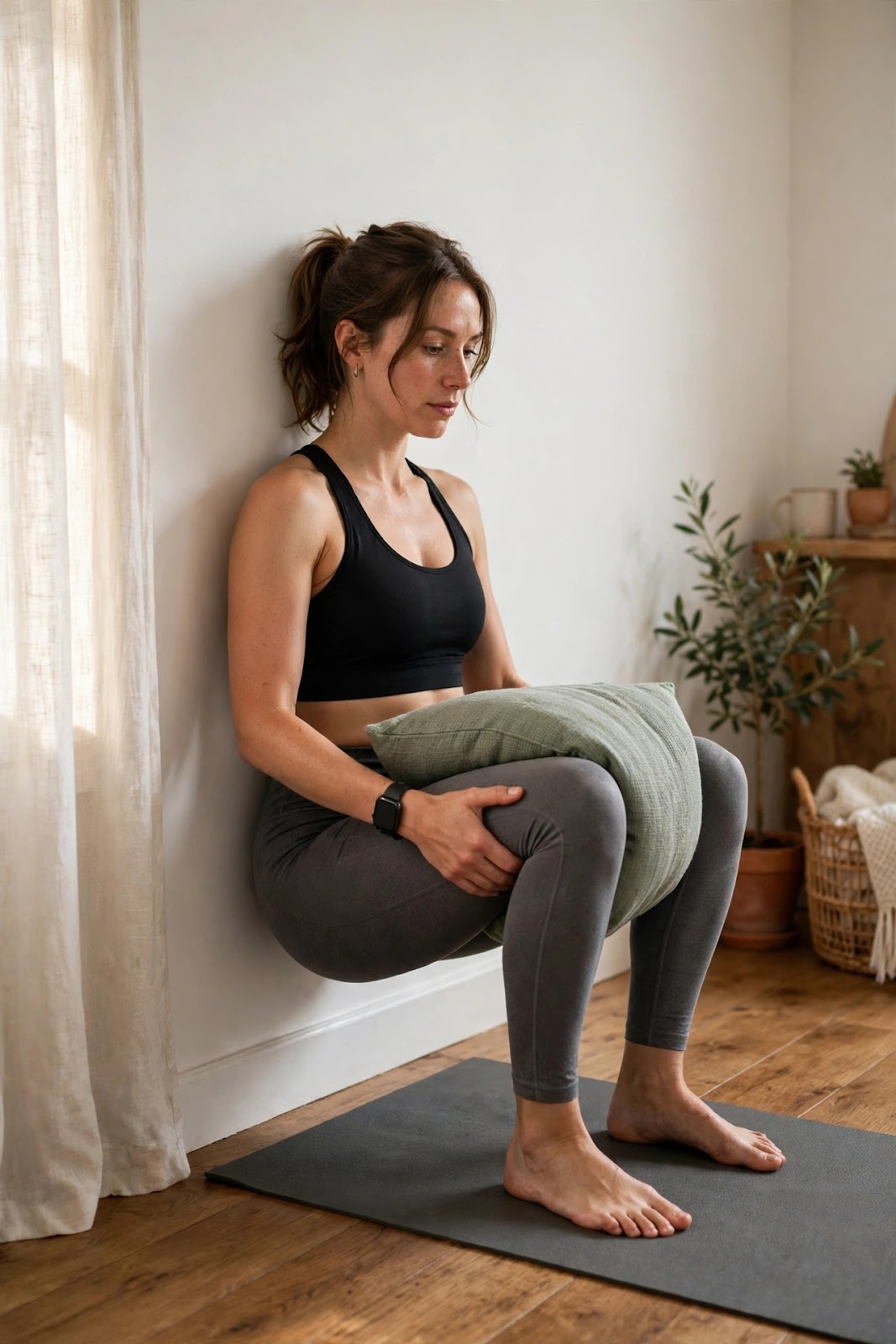
Stand with your back flat against the wall, feet about half a metre out, and slide down until your thighs are roughly parallel to the floor. Squeeze a cushion or a rolled towel between your knees and hold for thirty seconds. I don't own a Pilates ball, and a sofa cushion worked perfectly. My thighs burned by second twenty in week one. By week four I was holding forty-five seconds and actually breathing normally through it, which felt like a small miracle.
4. Wall plank with feet on the wall
Face away from the wall, hands on the floor, and walk your feet up the wall behind you until your body is in a straight line. Hold for twenty seconds. This one scared me the first time — I was convinced I'd slide face-first onto the rug. I didn't. I put a folded towel under my hands for grip, kept my feet low on the wall (about knee height), and it was fine. This move taught me more about keeping my ribs down and my belly braced than any crunch ever did.
5. Wall roll-down
Stand with your back against the wall, feet a small step forward, and roll down slowly, one vertebra at a time, letting your arms hang, until your hands dangle near your knees. Then roll back up just as slowly. Eight reps. This was my favourite by the end, because it doubled as a stretch for my tight hamstrings and a reminder to move my spine one piece at a time instead of folding like a deckchair.
What actually changed, week by week
Week one was mostly embarrassment and hamstring cramps. My hips wobbled during leg circles, my wall squat hold lasted twenty-two seconds before my legs gave out, and I wrote "this is harder than it looks" in my notebook three times. But something else happened in week one too: after each session, my lower back felt looser for the rest of the morning. Not fixed — looser. Enough that I noticed.
Week two, the moves started to click. I stopped thinking about my feet and started thinking about my breathing, which is when the exercises got harder in a good way. I added five seconds to every hold and my notebook started saying things like "leg circles steady today" instead of complaints. My posture changed in a way I only noticed when I caught my reflection in a shop window: I was standing taller without trying.
Week three was the turning point. I put on a pair of jeans I hadn't worn in months and they sat differently — not dramatically smaller, just flatter at the front, like my stomach had remembered how to hold itself in. My balance improved too. I used to wobble putting on socks while standing; now I didn't. Small stuff, but it adds up when it's your own body.
Week four, I did the full routine in twenty-two minutes and finished feeling energised instead of wiped out. My wall squat hold hit sixty seconds. My leg circles were smooth and my hips stayed still. And the back complaint that started this whole experiment? Gone. Not quieter — gone. I can't promise it'll do the same for you, because bodies are different, but that's what happened to mine.
The mistakes I made (so you can skip them)
Mistake one: going too fast. Pilates is slow on purpose. The first week I rushed through the leg circles like I was late for a bus, and all I got was sore hip flexors. When I slowed down — three seconds per circle — the exercise finally did what it was supposed to do.
Mistake two: holding my breath. I caught myself holding my breath during every wall plank, which made my face go red and my shoulders creep up to my ears. Exhale on the effort, inhale on the return. It sounds basic and it is basic, and I still had to remind myself out loud for two weeks.
Mistake three: skipping the roll-down because it felt too easy. It's the least impressive-looking move in the routine and the one my spine needed most. Don't skip the boring bits. The boring bits are usually the point.
Mistake four: doing it on a slippery floor in plain socks on day one. My feet slid, I overcorrected, and my lower back twinged. Grippy socks or bare feet on the mat, always.
Who I'd actually recommend this to
If you sit at a desk all day, if your back talks to you by 3 p.m., if high-impact workouts make your knees complain, or if you've never done Pilates and want a gentle way in — try this for two weeks before you judge it. It's quiet, it's cheap, and your neighbours will never hear a thing, which matters in my flat with its paper-thin floors.
It's not for everyone. If you're already deep into heavy lifting and want a challenge, wall Pilates will feel too gentle as your main workout — though I'd still argue it makes a brilliant warm-up or rest-day routine. And if you have a specific back problem, check with a physio first rather than taking a stranger's word on the internet. That's just common sense.
Here's what I know after thirty days: I started this as a sceptic with a piece of toast and a grudge against viral fitness trends, and I finished it with a stronger core, better balance, and a back that finally shuts up. The wall in my living room is now the most useful piece of gym equipment I own, and it cost me exactly nothing. My thirty-day experiment is over, but the routine isn't going anywhere — and honestly, neither is the wall.


