For about a year, I treated rest between sets like a personal failure. I'd finish a set of push-ups, glance at the clock, feel guilty for standing there doing nothing, and dive straight into the next set after fifteen seconds — breathing hard, arms shaking, form falling apart by rep four. I thought that's what hard training looked like. More sweat, less stopping, better results. My workouts felt brutal. My progress, though, had quietly stalled for months.
The wake-up call was embarrassingly simple. I was doing dumbbell rows in my living room — three sets of ten per arm — and on the third set my reps collapsed from ten to six to four, my back rounding, my shoulder doing all the work. I sat down on the floor, annoyed, and actually looked at the timer on my phone. I'd rested eleven seconds between sets. Eleven. I was basically doing one long, sloppy set and calling it three.
That evening I tried something that felt lazy and wrong: I set a timer for ninety seconds between every set. Ninety whole seconds of standing around in my own living room. The next workout, my reps stayed steady across all three sets. My form held. And I finished the session feeling like I'd actually trained, instead of feeling like I'd survived something. I've used a rest timer ever since, and it changed my home workouts more than any new exercise ever did.
The rushing habit (and why it feels so normal at home)
Here's the thing about training at home: nobody's watching, nobody's waiting for your equipment, and the whole session is squeezed between other parts of your day. That creates a specific kind of rush. You're aware the laundry needs doing, or dinner's in twenty minutes, or you've got a call at three. So you hurry. You cut corners you wouldn't cut in a gym, because at a gym the waiting is built in — you wait for the rack, you wait for the bench, you catch your breath because there's nothing else to do. At home, the only thing between you and the next set is your own impatience.
I rushed for a year and told myself it was "keeping my heart rate up." That was my excuse, and it sounded reasonable enough that I believed it. But here's what was actually happening: my muscles weren't recovering between sets, so every set after the first was weaker, sloppier, and less useful. I was doing more sets and getting less out of them. The total work looked impressive on paper — four sets! five sets! — but the quality of the work after set one was poor. I was tired, not trained. There's a difference, and it took me far too long to learn it.
The other problem with rushing: it made my workouts feel miserable. When every set starts with you already gasping, the whole session becomes something to endure rather than something to do well. I dreaded my workouts, not because they were hard, but because they felt chaotic. Ninety seconds of rest fixed that too, which I didn't expect. Standing still for a minute and a half, breathing normally, actually made me look forward to the next set instead of fearing it.
What ninety seconds actually does
I'm not going to pretend I understand the full science here — I'm a home trainer, not a coach — but the practical effect is easy to feel. After a hard set, your muscles are tired and your breathing is up. Given a minute or so, your breathing settles, your grip comes back, and the shaking stops. Given ninety seconds, you can usually do the next set almost as well as the one before it. Given eleven seconds, you can't, and everyone who has ever tried knows it. The timer just made me honest about the difference.

My rule now is simple: ninety seconds between sets of the same exercise, as a default. For easy moves — band pull-aparts, glute bridges, bodyweight squats — sixty seconds is plenty, and sometimes I cut it to forty-five if I'm short on time. For the hard ones — split squats, rows with my heaviest dumbbell, push-ups to near failure — I take a full two minutes, and I don't apologise for it. Legs get more rest than arms. Heavy gets more rest than light. That's the whole system. No spreadsheet, no app, just a phone timer and two numbers: sixty for easy, ninety to one-twenty for hard.
The funny part is that my workouts didn't get longer. They got shorter, in a way — or at least, they stopped sprawling. Before the timer, I'd do five ragged sets of everything because the first three were junk. Now I do three good sets and move on. The session ends sooner, and I've done better work. Rushing was costing me time, not saving it.
What I do during the ninety seconds
This is the part that makes or breaks the habit, because ninety seconds of standing still feels endless if you just stand there staring at the wall. I tried that for one session and nearly gave up the whole idea out of boredom. So I built a little rest routine, and it matters more than it sounds.
First ten seconds: I walk. Just a few slow steps around the living room, shaking out my arms, letting my breathing come down. Walking beats standing still — my legs stay warm, and moving a little stops the stiffness from creeping in. Then I take a sip of water. My bottle lives on the windowsill, exactly one walk away, which is deliberate: the little trip to the bottle fills ten seconds and keeps me moving. Then I check my form notes — I keep a small notebook on the coffee table with the day's plan, and I glance at the next exercise so I'm not scrambling when the timer goes off.
The last thirty seconds, I do nothing much. I stand near my mat, breathe, and think about the next set — how the last one felt, what I'll fix. One cue, usually. "Chest to the floor." "Elbows close." "Slow on the way down." One thing. That's it. When the timer buzzes, I start. No snoozing, no "just one more minute." The buzz is the boss now, and honestly, handing that decision to a timer is the best part. I don't negotiate with myself anymore.
The phone trap (and the one fix that worked)
I have to be honest about the biggest threat to this whole system: my phone. The timer lives on my phone, which means my phone is in my hand during every rest period, which means the phone is right there, glowing, full of notifications. For the first two weeks, my ninety-second rests kept becoming four-minute rests, because I'd check one message and fall down a little hole. My workouts got longer, my muscles cooled down too much, and I lost the thread of the session. The timer was working. I was the problem.
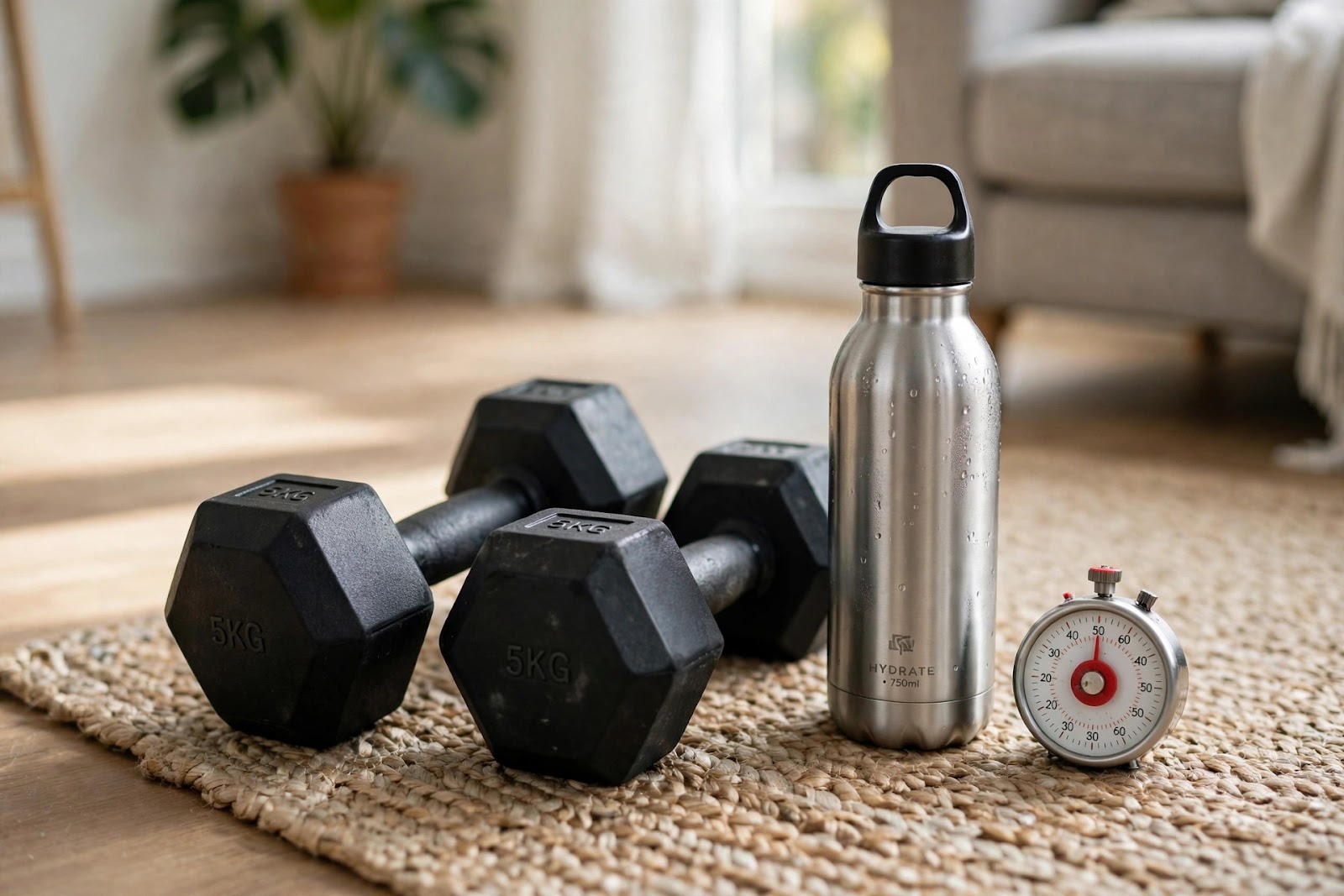
The fix was stupidly simple: I put the phone face-down on the windowsill, next to the water bottle, and I use the loud timer sound instead of watching the screen. Face-down, out of reach, buzzing when it's time. If a message comes in, I don't see it. My rest stays ninety seconds, my muscles stay warm, and the messages wait. They were always going to wait. Nothing in my inbox has ever been more urgent than the next set of split squats, and I say that as someone who used to check his phone between every set.
There's a second trap, too: the urge to fill rest time with "useful" extra exercises. I tried doing calf raises between push-up sets, and planks between rows, because it felt efficient. It wasn't. It just meant nothing ever rested, and everything got worse. Rest is the exercise, in a sense — it's the part where your body gets ready to do good work again. Filling it with more work is just rushing with extra steps. Now my rest is rest: walking, water, breathing, one cue. That's all.
One question I get when I mention the timer: what about circuits, where you move from one exercise straight to the next? Fair point — circuits are built to keep moving. My answer is that I still rest, just differently. In a circuit, I take the ninety seconds after the full round, not between exercises, and I take a shorter breather — thirty seconds or so — when I switch from a hard move to the next one. The principle is the same: the rest is part of the workout, not a gap in it. Even in a fast circuit, a little planned breathing beats a slow collapse into sloppy reps.
How to start (steal my exact setup)
If your home workouts feel stuck, or sloppy, or just miserable, try the timer for two weeks before you change anything else. Don't buy new equipment. Don't add exercises. Just add rest. Set your phone timer to ninety seconds between sets of the same exercise, sixty for the easy stuff, two minutes for the hardest moves. Put the phone face-down. Walk, sip water, breathe, pick one cue for the next set. Start when it buzzes.
Keep a tiny bit of track, because it's satisfying and it proves the point. I jot my reps in the notebook after each set — just the number. Before the timer, my rows went ten, six, four. After the timer, they went ten, nine, nine. Same weight, same exercise, same me. The only thing that changed was the rest. Seeing those numbers side by side in my own handwriting did more to convince me than any article ever could. If you try it, write the numbers down for the first week — future you will enjoy the comparison.
Two weeks is enough to feel it. If your reps hold steady across sets, if your form stops falling apart on set three, if you finish the session feeling worked rather than wrecked — that's the timer doing its job. And if ninety seconds feels too long at first, it will. It felt lazy to me, too, for about three sessions. Then it felt like the most obvious thing in the world: of course you rest between sets. That's what the rest is for.
I spent a year rushing through my workouts and wondering why I wasn't getting stronger. The answer was eleven seconds long, and it was standing right there between every set, waiting for me to notice it. Set the timer. Take the rest. Your next set will thank you — mine did, and it's never gone back.


