I Started Side-Stepping Down My Hallway — The Lateral Shuffle That Woke Up My Sleepy Hips in Three Weeks
My hallway is about four metres long, one metre wide, and until three weeks ago its only job was getting me from the front door to the kitchen. I walked down it forwards, the same as everyone else, hundreds of times a day, without ever thinking about it. Then a friend who plays football told me his coach made the whole team do lateral shuffles — side-stepping, basically — and said it was the one drill that kept his hips from feeling locked up after long weeks of sitting. I laughed at the time. Side-stepping down a hallway sounded like something a toddler does. Three weeks later, I'm the person side-stepping down my hallway every morning in my socks, and my hips have never felt more awake.
Here's the honest version: I sit a lot. I work at a desk, I eat at a table, I relax on a sofa, and nearly all of it happens facing forwards. Walking, sitting, standing — almost everything I do moves me in a straight line. My hips, meanwhile, are built to move in every direction, and I'd basically given them one job: go forward, go back, sit down. No wonder they felt sleepy. The lateral shuffle gave them a different job, and within a week they started answering.
This is the story of three weeks of side-stepping in a hallway: how I do it, what changed, the wobbly first attempts, and the small routine that's now stuck. No equipment, no gym, no special shoes. Just a hallway, a pair of socks, and a willingness to look slightly ridiculous for two minutes a day.
Why sideways? The movement I was missing
Think about your last twenty-four hours. How many times did you step sideways? For me, the honest answer before this experiment was: almost never. I sidestepped around a laundry pile once, maybe. Everything else was forwards and backwards. Stairs, pavements, corridors — all straight lines. Even my workouts were straight lines: squats go up and down, lunges go forwards and back, walking goes forward. My body had become very good at one direction and very rusty at all the others.
That rust showed up in small ways. Getting out of the car felt stiff. Stepping sideways to let someone pass in a narrow shop aisle felt clumsy. My hips felt tight when I tried to sit cross-legged on the floor, and getting up from a low sofa involved a little grunt and a hand on the armrest. None of this was dramatic. It was just the slow creep of only ever moving one way.
The shuffle fixes that by asking your hips to do the thing they've forgotten: move sideways under control. When you step to the side, the muscles on the outside of your hips — the ones that keep your pelvis level when you stand on one leg — have to switch on. Those are the same muscles that keep you steady when you carry shopping in one hand or step off a kerb. Mine, it turned out, had gone on a long holiday. The first week of shuffling was their wake-up call.
The first attempt (my cat thought I'd lost it)
Day one was a Sunday morning. I stood at one end of the hallway in my socks, faced the kitchen wall — sideways, so my left shoulder pointed down the hall — bent my knees slightly, and shuffled. Two steps in, my feet tangled, I stumbled into the wall, and my cat, who had been watching from the doorway, left the room. I don't blame her. I looked like someone trying to dance and forgetting the steps halfway through.
What went wrong was everything at once. I was taking steps that were too big, so my feet kept crossing over each other. My knees were straight, so every step jarred. I was looking at my feet instead of ahead, which threw my balance off. And I was going too fast, because in my head this was supposed to be easy, and easy things shouldn't need concentration. They do, apparently.
I slowed right down. Tiny steps, knees soft, eyes up, one foot following the other without ever crossing over. It felt absurdly slow, like a crab with a timetable. But by the third trip down the hall, something clicked: my hips were actually working. I could feel the outside of my hips — a spot I'd never really noticed before — doing the pushing. That feeling was new, and it was the reason I came back on Monday.
How I actually do it
Here's my version now, after three weeks of practice. I stand at one end of the hallway facing the wall, feet about hip-width apart, knees bent a little — not a deep squat, just soft, like I'm about to sit on a high stool. I keep my chest up and my eyes looking straight ahead at the skirting board on the opposite wall. Then I step sideways with my leading foot, about the length of one shoe, and bring the other foot to meet it, without letting my feet touch or cross.
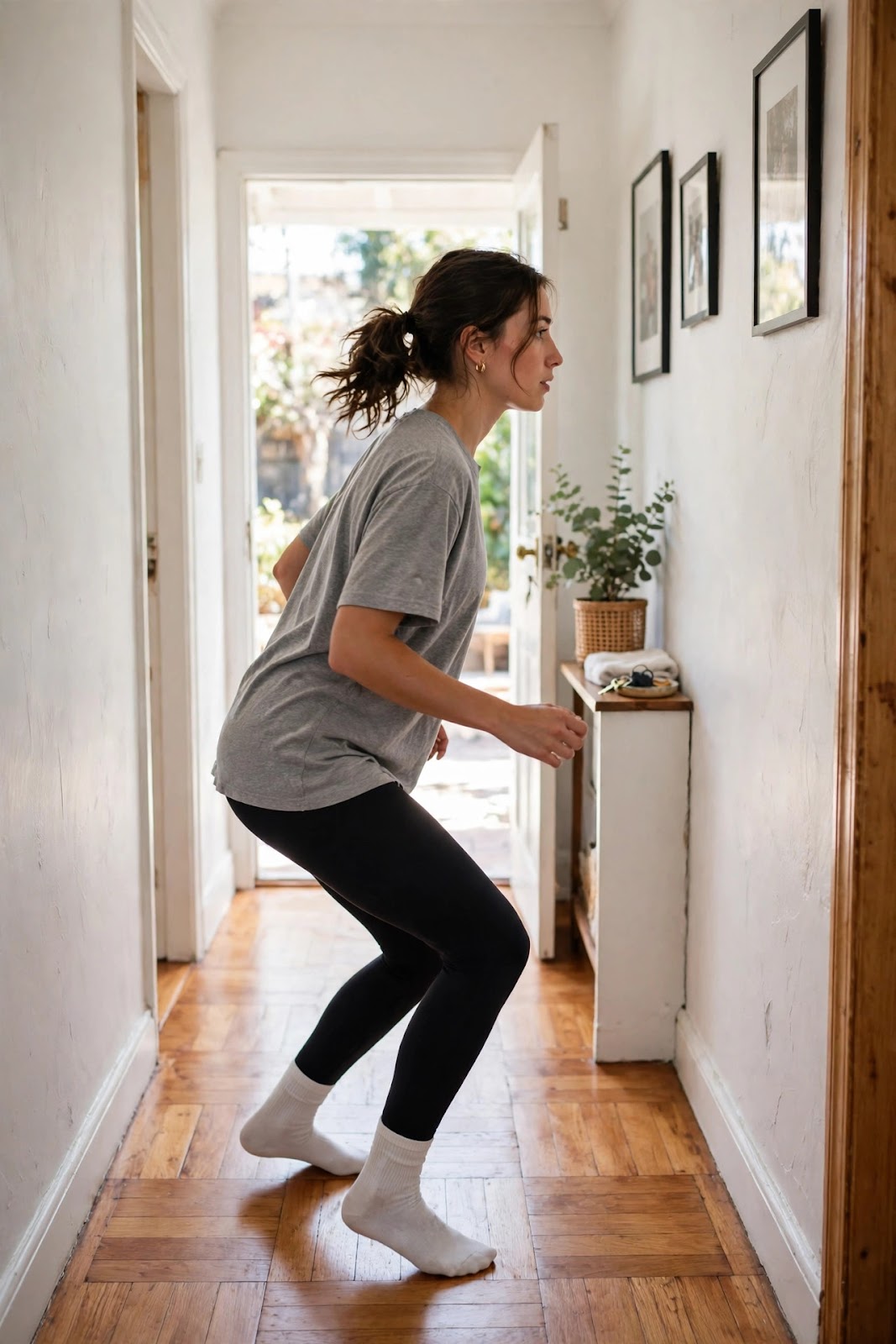
I go down the hallway that way — four metres takes about eight to ten steps — then I turn around, face the other wall, and shuffle back. That round trip is one set, and it takes about forty seconds. I do four sets, which is roughly three minutes including the little pauses when I turn around. I do it in the morning, after my stretches, while the kettle boils. Same cue as my other habits: kettle on, move a little, tea ready.
A few details that matter more than they sound. I keep my feet pointing forward, not turned out like a duck. My steps stay small — if my feet cross, I've gone too far. I stay low the whole time; if I stand up straight, the work slides out of my hips and into my knees, and my knees notice. And I breathe normally, which sounds obvious until you catch yourself holding your breath on step three. I did that for a whole week before I noticed.
I do it in socks on a wooden floor, which gives me just enough slide to feel smooth but not so much that I slip. If your hallway is carpeted, bare feet or trainers work better. If it's tiled and slippery, wear trainers with grip. The floor matters less than the control: slow, small, steady steps, hips doing the work.
The mistakes that made week one feel pointless
I made four mistakes in the first week, and fixing them changed everything. Mistake one was steps too big. I was lunging sideways like I was trying to cover the hallway in three giant steps, and my feet kept crossing and my balance kept going. Small steps felt silly and slow, but small steps are the whole exercise. One shoe-length at a time. If you finish the hallway in fewer than eight steps, your steps are too big.
Mistake two was straight legs. I kept locking my knees because standing with bent knees felt like hard work, and — surprise — it is hard work, that's the point. The bend is what loads the hips. When I finally stayed in a soft squat for the whole hallway, my thighs started burning by the third set, and that burn told me the right muscles were finally involved. If your legs don't feel anything, you're probably standing too tall.
Mistake three was looking down. I watched my feet like they might run away, and every time I looked down, I wobbled. Picking a spot on the wall at eye level and keeping my eyes there fixed my balance almost instantly. It also stopped me from hunching over, which had been making my neck ache by the end of each set. Eyes up, chest up, feet do their own job without supervision.
Mistake four was only going one way. For the first three days I only shuffled to the left, because turning around and facing the other wall felt like extra effort, and I told myself the direction didn't matter. It does. One direction works one side more than the other, and by day three my left hip felt worked and my right hip felt like it had stayed in bed. Now I always go both ways, equal sets each direction, even when one side feels clumsier than the other. Especially then.
Week by week: what changed in my hips
Week one was mostly about not tripping. I did four sets a morning, both directions, and my hips felt oddly tired by the end — not sore, just used, like a muscle that's been woken from a nap. My knees felt a bit grumbly on day two because I'd been standing too tall and letting them take the load. Bending my knees more and shortening my steps sorted that out by day four. By the end of the week, I could get down the hallway without looking at my feet, which felt like a genuine achievement, even if it sounds small written down.
Week two was when the changes started showing up outside the hallway. I stepped off a kerb carrying a bag and landed steady instead of wobbling. I got out of the car and my hips didn't need their usual three-step warm-up before they felt normal. Sitting cross-legged on the floor to sort out a drawer — something I usually avoid because getting up again is a production — felt easier, and getting up felt smoother. I didn't trust it at first. I kept waiting for the stiffness to come back. It kept not coming back.
Week three is where I am now, and the change I notice most is how my hips feel when I walk. My stride feels a little wider and more stable, like I'm planted properly instead of balancing on a narrow line. Stairs feel steadier too, especially going down, which used to be the wobbly part for me. I won't oversell it: I didn't become an athlete in three weeks. I became a person whose hips work when she asks them to, in more than one direction, and that has made ordinary days noticeably easier.
The tiny progressions that kept it interesting
After about ten days, four sets started feeling easy, and I needed a way to make it slightly harder without buying anything or making it complicated. The first progression was staying lower — dropping my hips another inch and keeping them there for the whole hallway. That one inch changed everything. My thighs burned by the second set, and my hips had to work much harder to push me sideways. I only stay low on two of the four sets, because four low sets leave my legs shaky for the stairs afterwards, and shaky legs on stairs are not a good combination.
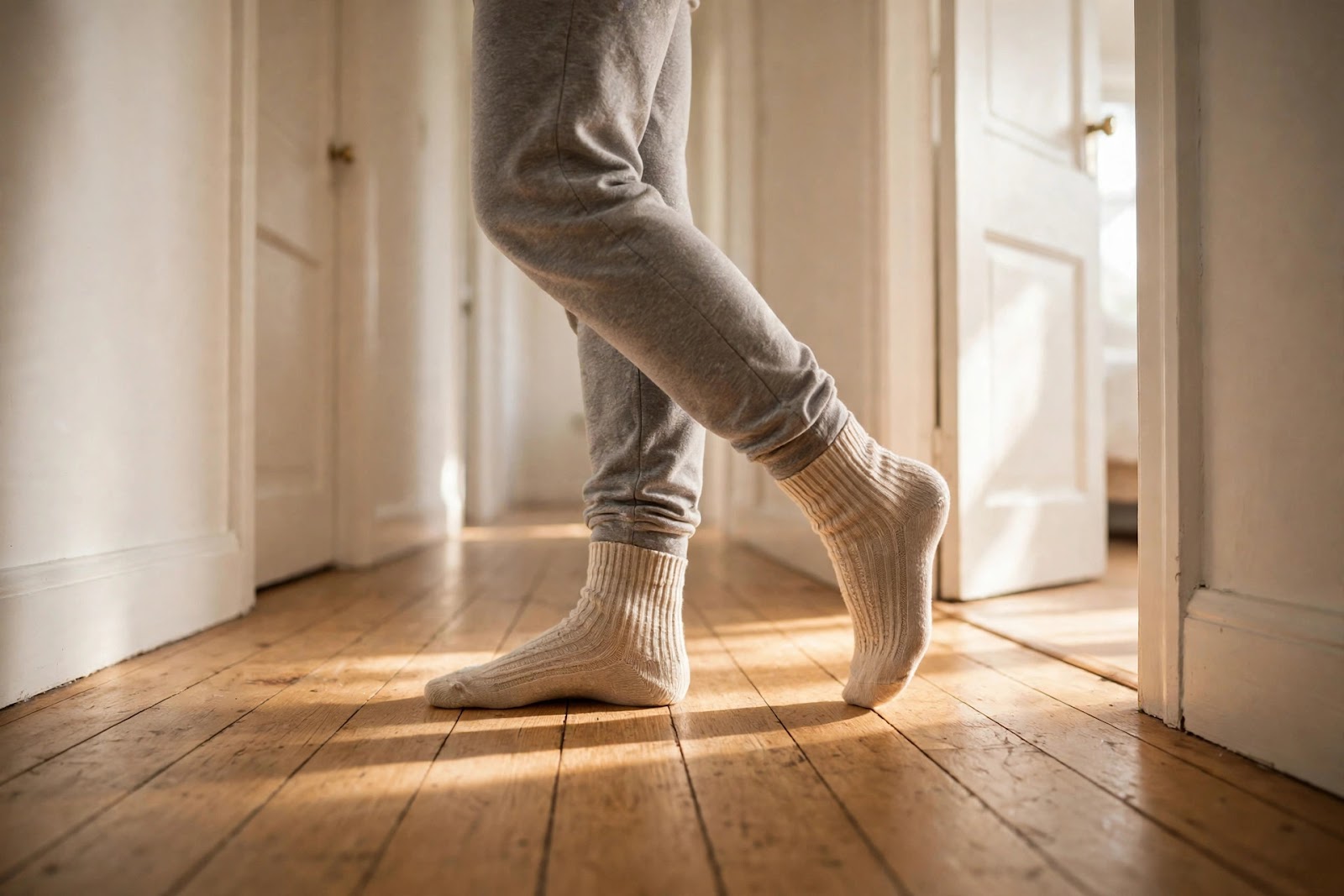
The second progression was a pause. On the way back down the hall, I pause for two seconds on one leg each time my feet come together — just a brief single-leg balance before the next step. It slows the whole thing down and adds a balance challenge that my ankles notice immediately. Some mornings my balance is great and the pauses feel easy. Other mornings, especially if I slept badly, I wobble on every pause, and I take that as information: slow down, shorten the steps, be kind to the tired version of me.
The third progression was the simplest: I added a set. Five sets instead of four, on the days I feel good. That takes the whole thing from three minutes to about four, and it's enough extra work that my hips notice, without turning a tiny habit into a workout I dread. I never do more than five sets. The day a two-minute hallway habit becomes a fifteen-minute production is the day I stop doing it, and I know myself well enough to guard against that.
The hallway as a gym (and other places it works)
My hallway works because it's always there and I pass through it a dozen times a day. But the shuffle doesn't need a hallway specifically — it needs about three or four metres of clear floor and a wall to face. I've done it in my kitchen, between the counter and the table, when the hallway was blocked by a drying rack. I've done it in my living room, shuffling along the front of the sofa. The space just needs to be clear enough that you won't trip over a shoe or a bag.
If you live in a small flat with no hallway at all, two metres is enough — you just turn around more often. If your floor is slippery, wear trainers. If you've got downstairs neighbours, the shuffle is beautifully quiet: no jumping, no thumping, just soft sock-steps on wood. My neighbours have never heard a thing, and I checked by asking, because the last thing I want is to be the person making mysterious sideways noises at seven in the morning.
One practical note: clear the hallway first. I tripped over a pair of shoes on day five because I'd left them by the door, and that was the end of that morning's shuffle — I did the rest of my sets in the kitchen instead, which worked fine, but it taught me to keep the hallway clear the night before. Now the shoes live on a rack by the door, and the hallway is a hallway again, not an obstacle course.
What it didn't change (keeping it honest)
Three weeks of shuffling did not make me flexible in the splits, did not fix my tight shoulders, and did not replace my walks. My shoulders still need their own stretches, and the days I skip my walk, my whole body notices, shuffle or no shuffle. The shuffle is a hip drill, not a whole fitness plan, and I don't want to pretend otherwise.
It also didn't make my legs stronger in the way squats do. My thighs feel more awake, but if I want real leg strength, I still need the heavier work — the squats, the step-ups, the things that genuinely load the muscles. What the shuffle gave me was different and narrower: hips that move sideways without complaint, balance that holds when I step off a kerb, and a feeling of steadiness in ordinary movement. That's a specific win, and it's the one I needed.
And one more honest note: the first week felt silly. Side-stepping down a hallway in your socks feels like a joke exercise, and part of me kept waiting for someone to walk in and ask what on earth I was doing. Nobody did, and by week two I'd stopped caring. The results were doing the talking by then, and results are much louder than embarrassment.
How to start tomorrow morning
If you want to try this, here's the version I'd hand you. Clear a few metres of floor — hallway, kitchen, living room, anywhere. Stand sideways to the direction you're going to travel, feet hip-width apart, knees soft. Pick a spot on the wall at eye level and look at it. Step sideways one shoe-length, bring the other foot to meet it without crossing, and repeat. Go one way, turn around, come back. That's one set. Do three sets tomorrow, both directions, and see how your hips feel.
Start with three sets, not five. Three sets takes about two minutes, and two minutes is a habit you can keep. When three feels easy — give it a week — add a fourth set. When four feels easy, try staying a little lower for one set. That's the whole progression, and it will carry you for a month or more. Write down one line a day if you like tracking: "wobbly, knees sore" or "steadier, hips awake." Those lines add up to a story, and the story is what keeps you going on the mornings when the hallway looks boring.
And if you trip on day one, welcome to the club. I tripped on day one, my cat left the room, and I still came back on day two. The wobble is the work. The sideways step is the whole point. Three weeks from now, your hips might just thank you — mine certainly have.


