Day one, I cleared a space between the sofa and the coffee table, rolled out a mat I'd owned for two years and used maybe four times, and did ten squats. Ten. My legs shook on the last two. I remember standing there thinking, this is embarrassing, I'm the kind of person who gets winded by ten squats in her own living room. Then I did ten push-ups from my knees, a 20-second plank that felt like a minute, and I was done in about twelve minutes. I wrote it down in a notebook because I'd read somewhere that tracking keeps you honest. It does. Seeing "Day 1: 10 squats, 10 knee push-ups, 20s plank" in my own handwriting made quitting feel like breaking a promise to myself, and I'm stubborn about promises, even the small ones.
I'd tried the gym twice in my life. The first time I lasted three weeks before the commute killed it — forty minutes there, forty back, for a forty-five-minute workout. The maths never worked. The second time I signed up in January with everyone else, went eleven times, and quietly stopped going in March while still paying until June. So when I decided to get stronger this autumn, I set one rule: no gym, no equipment, no commute. Just my living room, my bodyweight, and thirty days to see what would actually happen.
The plan I made was deliberately boring. Five moves, three rounds, four days a week, with rest days in between. Squats, push-ups, glute bridges, a plank, and reverse lunges. That's it. No fancy variations, no jumping, nothing that would make my downstairs neighbour hate me. Each session was supposed to take twenty minutes, and I gave myself permission to stop after one round on bad days, as long as I showed up. That permission mattered more than I expected.
What Nobody Tells You About Week One
Week one humbled me in ways I hadn't predicted. It wasn't the soreness, though there was plenty of that. On day three I sat down on the sofa and my thighs staged a full protest. Getting off the toilet the next morning required a strategy. What surprised me was how bad my balance was. Reverse lunges made me wobble like I'd had three glasses of wine. My left leg was noticeably weaker than my right, which I only discovered because bodyweight work doesn't let a stronger side cover for a weaker one the way a machine does. There's nowhere to hide when it's just you and gravity.
The other surprise was how quickly my body started adapting. By day six, the same ten squats that had burned on day one felt... fine. Not easy, exactly, but manageable. I added five more reps. That's the thing about starting from a low base: progress shows up fast, and fast progress is addictive. I started looking forward to the sessions, which had never once happened to me at a gym.
I also learned something practical in that first week. Work out in socks on a hard floor and your feet slide during lunges. A cheap yoga mat fixed it, but so did simply doing lunges on the rug. And if your living room is small like mine — mine is about three metres by four — you need to pick a layout and stick with it. I kept the coffee table pushed against the wall for the whole month. It became part of the routine: push table, roll mat, open window, go.
The Push-Up Problem
Push-ups were my nemesis. On day one I did ten from my knees and my arms were shaking. Proper push-ups from my toes felt impossible. So I did what felt like cheating but isn't: I used the sofa arm. Hands on the sofa arm, body at an angle, ten slow reps. Every few days I moved to something lower — the coffee table, then a stack of books, then the floor on my knees, then finally, on day eighteen, three real push-ups from my toes. Three. I celebrated like I'd won something, because in a way I had.
Here's what I wish someone had told me years ago: the push-up isn't one exercise, it's a ladder, and every rung counts. Incline push-ups against furniture are not a lesser version. They're the same movement with less load, and they build the exact strength you need for the floor version. The mistake I kept making in past attempts was jumping straight to the hardest version, failing, and deciding I was bad at push-ups. I wasn't bad at push-ups. I was bad at progression.
By day thirty I could do eight clean push-ups from my toes, chest to about a fist's height above the floor, no sagging hips. My arms looked different in the mirror, too — not dramatically, but there was a shape in my shoulders that hadn't been there before. My sister noticed before I did. "Have you been doing something with your arms?" she asked, and I tried very hard not to look smug.
What Changed in My Body
Let me be honest about what thirty days of bodyweight training does and doesn't do. I didn't transform. Nobody would mistake me for an athlete. But the changes were real and, frankly, bigger than I expected from twenty minutes a day in my living room.

First, my legs. I could do three sets of twenty squats by the end, and stairs stopped being an event. I live on the third floor, and the walk up with groceries used to leave me breathing hard at the second landing. By week four I was carrying two bags up without stopping. That's not a gym metric, it's a life metric, and it mattered more to me than any number.
Second, my core. The plank went from twenty seconds of trembling to a full minute, and I added side planks in week three. The real payoff showed up in the most boring place possible: sitting at my desk. I stopped slumping by mid-afternoon. My lower back, which used to ache by 4 p.m. every day, just... didn't. I hadn't expected a core routine to fix my sitting posture, but that's exactly what happened.
Third, my balance. Those wobbly reverse lunges became steady. I could stand on one leg to put my socks on without grabbing the wall. Small thing, but it felt like getting younger in a very specific, practical way.
I also lost about a kilo and a half. I wasn't dieting, and I didn't change what I ate much — I had a bit more protein at breakfast because I read it helps recovery, mostly eggs and Greek yoghurt — so I won't pretend the workouts melted weight off me. What changed was the shape of things. My jeans fit differently. My waistband sat the same, but my thighs filled the legs out more. Muscle takes up space differently than fat, and at thirty days the shift was visible enough that I noticed it getting dressed.
The Mental Shift Nobody Warned Me About
The biggest change wasn't physical at all. It was the way I started thinking about myself. Before this month, "exercise person" was a category I wasn't in. I was the person who meant to start on Monday. Doing something hard, briefly, four days a week, rewired that. I kept a streak going. I missed one session — day fourteen, I had a migraine and spent the day horizontal — and instead of the whole thing collapsing the way my gym attempts always did, I just did it the next day. One missed session didn't end the experiment because the experiment lived in my living room, five steps from my bed. There was no membership to cancel, no commute to dread, no audience.
That low barrier is the whole secret, I think. The best workout is the one you'll actually do, and the one you'll actually do is the one with the fewest excuses built in. My living room has zero excuses. The mat is always there. The sofa arm is always there. It takes less time than an episode of a show, and I do it in the same clothes I wear around the house half the time.
I also stopped dreading exercise, which I genuinely didn't think was possible. There were days I didn't want to start, sure — day nine, a grey rainy Tuesday, I stood on the mat for a full minute doing nothing before I finally started. But I never once regretted finishing. Not once in thirty days. That's a strange thing to be able to say honestly.
The Mistakes I Made (So You Don't Have To)
I made plenty. The first was going too hard on day four because day three had felt okay. I doubled my squat reps in one jump and spent two days walking like a cowboy. Progression should be boring and small — two or three extra reps, not ten. Your body adapts fast, but it punishes greed.
The second mistake was skipping warm-ups in week one because "it's only bodyweight." It's only bodyweight until your cold hamstring cramps halfway through a lunge. Two minutes of marching in place, arm circles, and leg swings before each session fixed that completely, and I've done it every time since.
The third was comparing my day ten to someone else's day three hundred. I watched a video of a woman doing pistol squats in her kitchen and felt briefly pathetic about my knee push-ups. Then I remembered she was showing me her highlight reel and I was on day ten of my real life. Comparison is the fastest way to quit something that's working.
The fourth mistake: I didn't stretch after sessions for the first two weeks. My hips got tight, my calves got tight, and everything felt stiff in the mornings. Five minutes of stretching at the end — a standing quad stretch, a hamstring fold, a chest opener against the doorframe — sorted it out. The cool-down isn't optional, no matter how short the workout is.
My Exact Routine, Week by Week
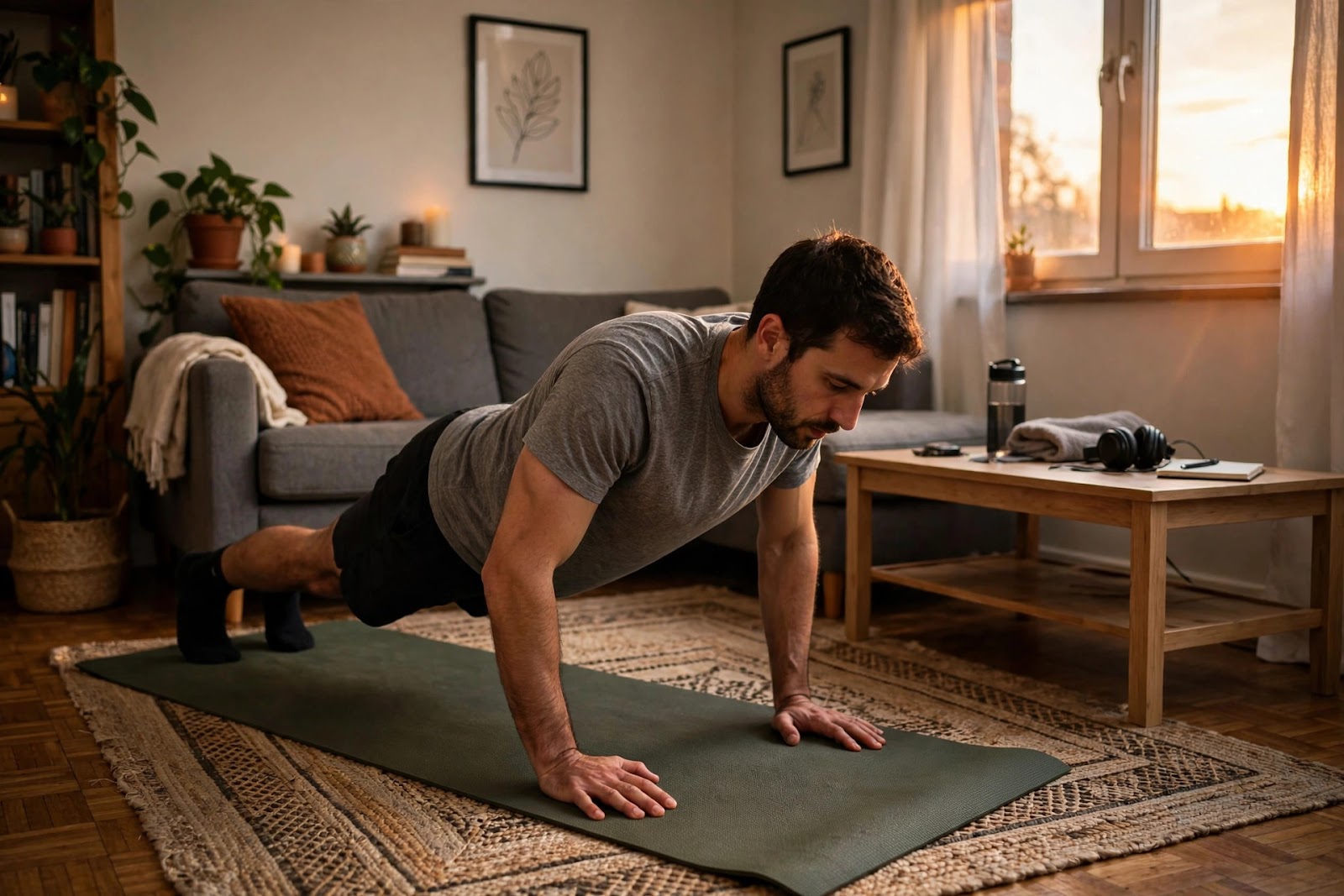
People keep asking me what I actually did, so here's the honest breakdown. Four days a week — Monday, Tuesday, Thursday, Saturday, with Wednesday, Friday, and Sunday off. Each session: five minutes of warm-up, the circuit, five minutes of stretching.
Weeks one and two, three rounds of: 10 squats, 8 incline push-ups, 12 glute bridges, 20-second plank, 6 reverse lunges per leg. Rest 60 seconds between rounds. Total time, about eighteen minutes.
Weeks three and four, three rounds of: 15 squats, 10 push-ups (lower incline, then floor from knees), 15 glute bridges, 30-second plank plus a 20-second side plank each side, 8 reverse lunges per leg. Rest 45 seconds between rounds. Total time, about twenty-two minutes.
That's the whole programme. No equipment, no app, no subscription. A notebook, a mat, and a sofa arm. If you want to try it, start even easier than I did. Ten squats is a fine day one. The point is day two, and day thirty.
What I'd Do Differently Next Time
I'd add a pulling movement. Bodyweight push-ups and squats are great, but after thirty days my front felt stronger than my back, and I could tell. A sturdy table lets you do inverted rows — lying underneath, pulling your chest to the edge — and I wish I'd started those in week two instead of discovering them in week four. Next month, rows join the circuit.
I'd also take a photo on day one. I didn't, because I was sure I'd quit and didn't want evidence. Now I wish I had a before-and-after, not for anyone else, just for me. Measurements work too — waist, hips, thighs, arms — but a photo tells the truth faster.
And I'd tell someone. I kept the whole month secret, which meant nobody asked me how it was going, and on the hard days I had no one to answer to. Telling my sister in week three, after she'd noticed my arms, made the last stretch easier. Accountability doesn't have to be a coach or an app. It can be one person who knows.
The Sleep Bonus I Didn't See Coming
One change I never expected: I started sleeping better. Not dramatically — I didn't suddenly become a person who falls asleep in seconds — but I stopped waking up at 3 a.m. with a restless, achy feeling in my hips. I think the evening sessions helped; on the days I worked out after dinner, my body felt pleasantly tired by bedtime in a way that sitting on the sofa never produced. There's something about using your muscles, even gently, that tells your body the day is actually over. I also noticed I stopped reaching for my phone as much in the evenings. The workout gave my hands and my head something else to do for twenty minutes, and that small break from scrolling made the whole evening feel calmer. It's a strange side effect for a squat routine, but I'll take it.
Would I Recommend It? Honestly, Yes
Thirty days of bodyweight workouts in my living room didn't change my life. It changed my mornings, my stairs, my posture, and my opinion of myself as someone who exercises. That last one might be the most valuable change of all, because it's the one that makes day thirty-one happen.
I'm still doing it. The experiment ended on a Sunday, and on Monday I rolled the mat out again, because stopping felt stranger than continuing. I've added the table rows, I'm working toward ten full push-ups, and the coffee table still lives against the wall. My living room is a gym now, at least for twenty minutes a day, and honestly it suits me better than any gym ever did.
If you've been waiting for the right time, the right gym, the right programme — this is your sign that the right time is a mat on your living room floor and twenty minutes you already have. Start with ten squats. See what happens by day thirty. I think you'll be surprised.


